
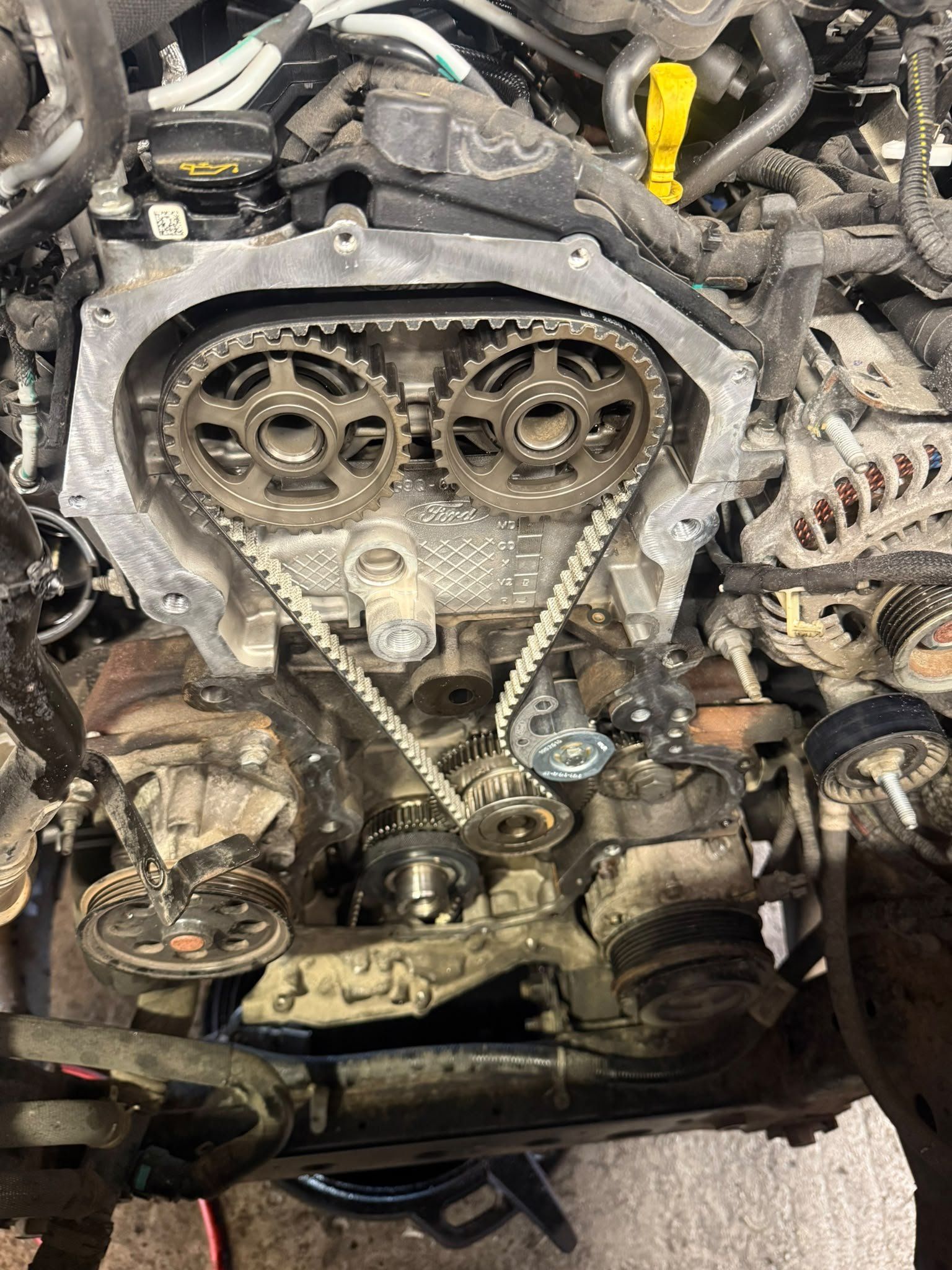
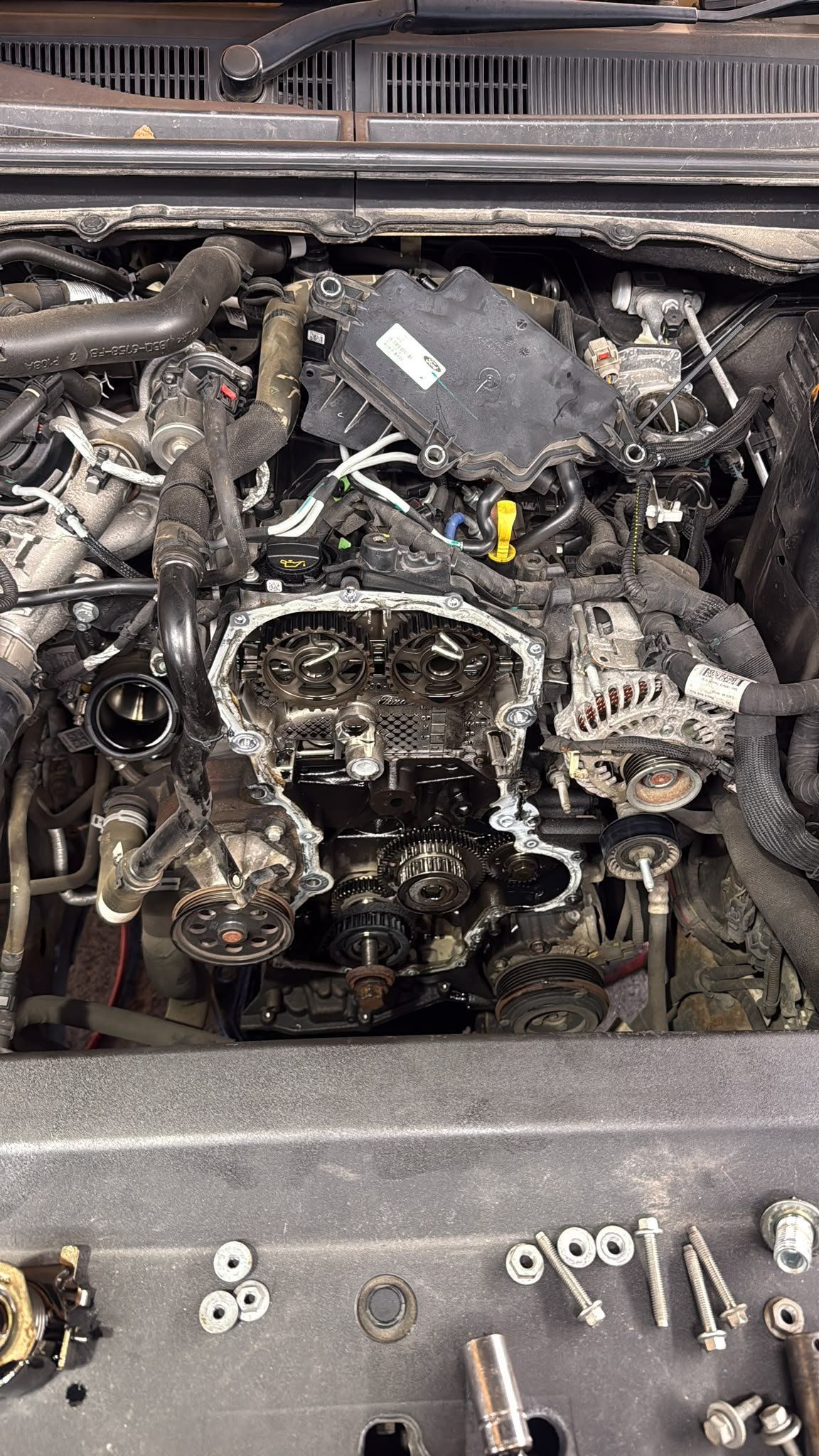
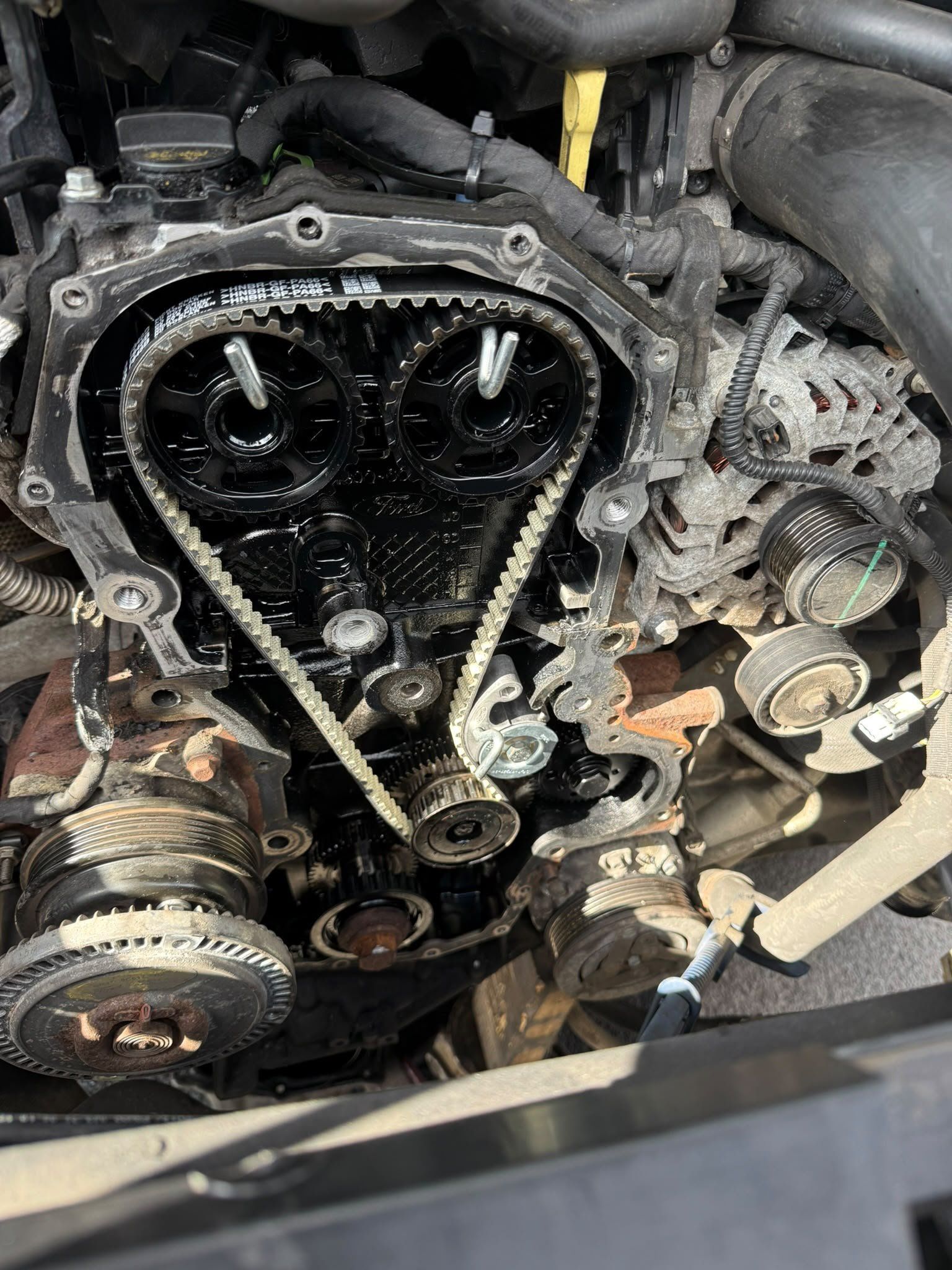
The Ford 2.0 EcoBlue diesel drives its camshafts with a toothed belt that runs inside the engine, in the oil. It is a good engine while the belt and the oil are looked after, and an expensive one when they are not. On a van that earns a living, the cost is time off the road as well as the repair. This page covers which Transits have the belt, when it is due, and what to look out for.
Which Transits have the wet belt
The 2.0 EcoBlue went into the Transit and Transit Custom vans and the Tourneo Custom from around 2016, replacing the older TDCi diesels. If your van has the 2.0 EcoBlue, it has a wet belt.
The 1.0 petrol Transit Connect and Transit Courier use the 1.0 EcoBoost, which has a different wet belt; that job is on the 1.0 EcoBoost wet belt page. Ford has used several engines across the Transit range, so if you are not sure what is under the bonnet, send the registration on WhatsApp to 07578 178468 and ask.
Ford’s revised interval
Ford originally gave the 2.0 EcoBlue belt an interval of 10 years or 150,000 miles. It has since cut that to 6 years or 100,000 miles, whichever comes first, for the timing belt, tensioner and idlers on Transit and Transit Custom vans and Tourneo models with this engine.
That change catches a lot of vans out. A van that was serviced to the original schedule, or bought second-hand with a service book showing the old figure, may already be past the new one. The age limit is the one people miss: a van doing modest mileage reaches six years long before it reaches 100,000 miles. Your service book and the van’s first registration date settle it.
Why the belt wears
A wet belt is made to live in one specification of oil, at the right level, changed on time. The things that wear it faster are the same on a van as on a car, and a working van tends to see more of them:
- The wrong oil. An oil that does not meet the specification Ford gives for your engine can make the belt swell, soften and shed material.
- Stretched oil changes. Old oil carries more soot and fuel, and both are hard on the belt. Vans on long service intervals, or that miss a service when work is busy, are most at risk.
- Idling and short hops. Multi-drop work and long spells at idle keep the oil from reaching full temperature, so it ages faster.
What happens when it goes wrong
A worn belt usually breaks up before it breaks. Fragments come away and the oil carries them to the sump, where the oil pump draws its supply through a pickup and a fine mesh strainer. As the strainer blocks, oil pressure falls.
Low oil pressure damages bearings and the turbocharger quickly, and a belt that jumps a tooth or fails upsets the valve timing. Either way, a planned belt change is a fraction of the cost of the engine work that follows a failure.
Warning signs
Often there are none until the damage is under way, which is why the belt is best changed on time. Have the van looked at if you see:
- the oil pressure warning light, even a flicker at idle
- a new rattle or ticking from the engine
- rough running, loss of power or the engine management light
- black flecks or grit on the dipstick
If the oil pressure light comes on while you are driving, stop as soon as it is safe and switch off. Driving on without oil pressure is how a belt job becomes an engine.
How the job is done
The belt is a timing belt, so the camshafts and crankshaft are locked in position with the right locking tools before anything is removed, and the new belt goes on to the manufacturer’s timing. Getting that wrong by a tooth is enough to cost power or worse. Alex is a Bosch advanced apprenticeship graduate who has worked at Ford, Jaguar Land Rover and Aston Martin, with 15 years in the business.
Booking a working van
A van in for a belt is a van not out earning, so it pays to plan the job rather than wait for a warning light. Call or WhatsApp 07578 178468 with the registration and the mileage, and Alex will confirm whether it is due, the price, and a day to bring it in. If you run more than one van, say so, and they can be booked so they are not all off the road at once.
Coming from further away
The workshop is in Sarratt, near Rickmansworth, a short drive from Chorleywood, Croxley Green, Kings Langley, Abbots Langley and Watford.