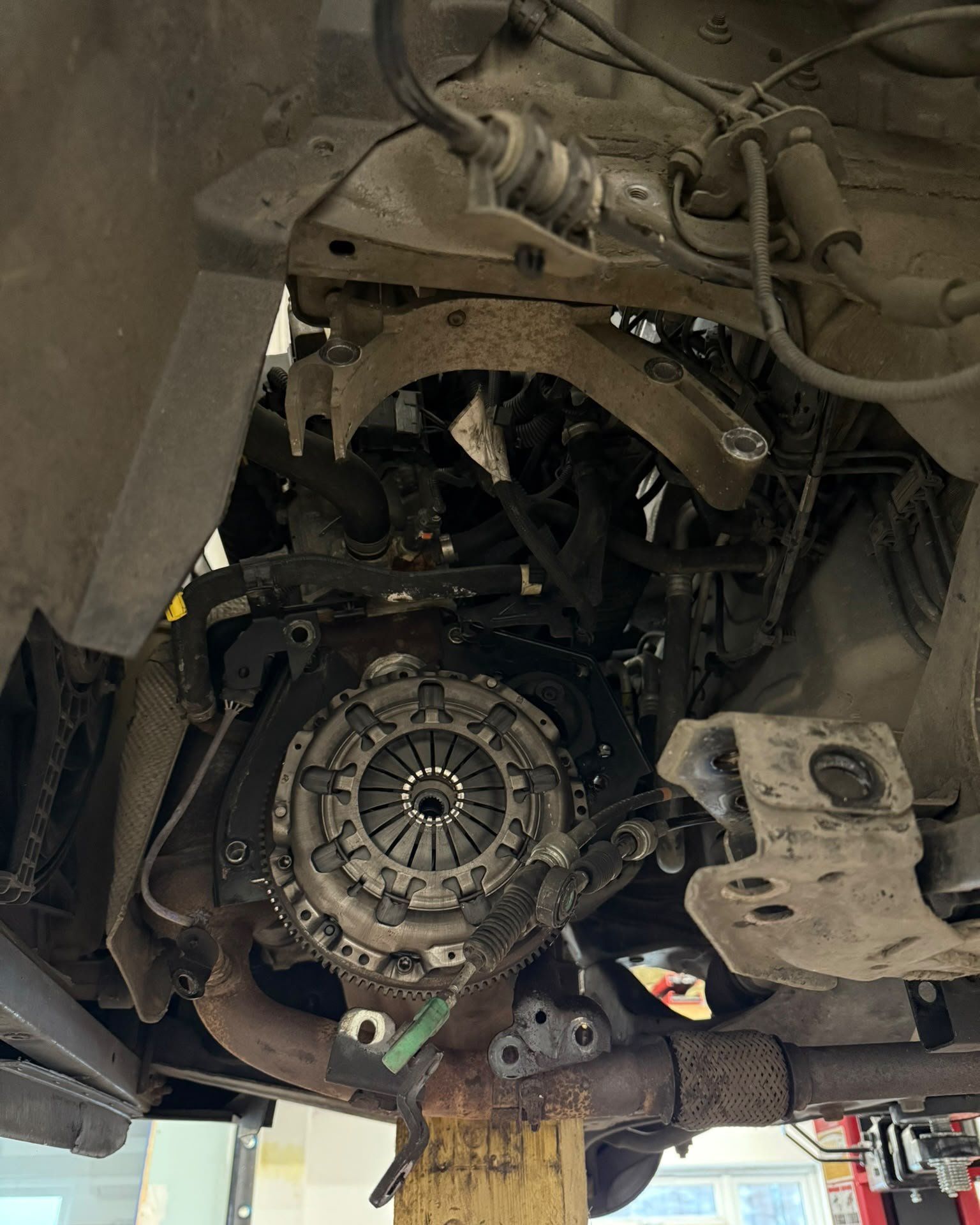
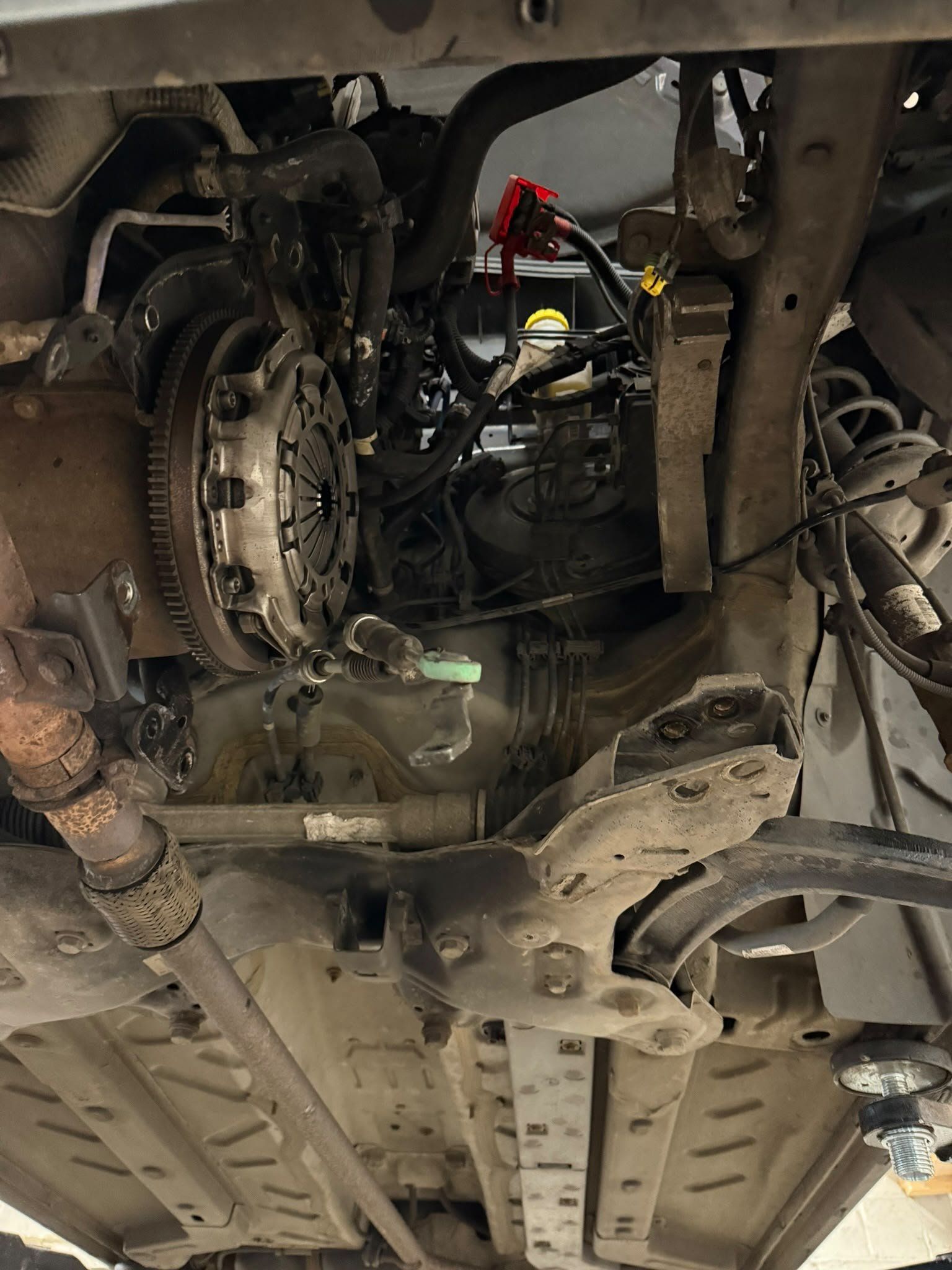
A clutch is a wear part. Every time you pull away or change gear, the friction plate slips a little against the flywheel until the two lock together, and over the years that friction material wears thin. When it does, the clutch has to come out, and on almost every car that means taking the gearbox out first.
What gets replaced
A clutch is normally replaced as a kit, because the parts wear together and the labour to reach them is the larger part of the job:
- the friction plate, the disc that wears
- the pressure plate (or clutch cover), the spring assembly that clamps it
- the release bearing, which the pedal pushes against every time you press it
Many modern cars use a concentric slave cylinder, a hydraulic release bearing that sits inside the bellhousing. It can only be reached with the gearbox out, so it is often replaced at the same time.
The flywheel
The flywheel is the heavy disc on the back of the engine that the clutch clamps against. Many diesels and a good number of petrol cars use a dual-mass flywheel, made in two halves with springs between them to soak up engine vibration. Dual-mass flywheels wear too, and a worn one can cause judder, a rattle at idle, or a clunk when the engine is switched off.
With the gearbox out, the flywheel should always be checked. If it is worn or out of tolerance it is replaced with the clutch; fitting a new clutch to a failing flywheel usually means doing the whole job again soon after. A worn flywheel adds noticeably to the cost, which is why it is checked rather than assumed.
Signs your clutch is going
- Slipping: the revs rise but the car does not speed up to match, most noticeable in a high gear going uphill or overtaking
- A high biting point: the clutch only takes up near the top of the pedal’s travel
- Judder when pulling away, especially in reverse or on a slope
- A burning smell after a hill start or a tight manoeuvre
- Difficulty selecting gears, or grinding going into gear
- Noise that appears or disappears when you press the pedal, often the release bearing
Is it the clutch or the hydraulics?
Most cars operate the clutch hydraulically: a master cylinder at the pedal pushes fluid to a slave cylinder at the gearbox. Faults in that system feel like clutch trouble but are a different repair. A pedal that feels soft or spongy, sinks to the floor and stays there, or does not fully disengage the clutch can point to a leak or a failing cylinder rather than a worn clutch. On many cars the clutch shares its fluid with the brakes, so a dropping brake fluid level can also be a clue.
Some cars, mostly older ones, use a cable instead, which can stretch or snap. Gearbox problems, from bearings to worn synchromesh, also overlap with clutch symptoms. Diagnosing which it is before quoting is the first step; see car diagnostics and gearbox rebuilds.
Why it is a workshop job
To change a clutch, the gearbox comes out from underneath the car. That means supporting the engine, separating driveshafts and the gear linkage, and lowering a heavy gearbox safely, then lining it all back up. It is a job for a ramp, not a driveway. SOMA Autos works from a unit in Sarratt with ramps.
Vans
Clutches on vans work the same way and wear faster under load, with towing, and in stop-start delivery work. If you run a Ford Transit, it is also worth knowing when its wet belt is due, so both jobs can be planned rather than found out about.
Getting a quote
The price depends on the car, the clutch kit it takes, and whether the flywheel needs replacing. Call or send a WhatsApp to 07578 178468 with the registration and a description of what the car is doing, and Alex will quote and book it in. Alex has 15 years in the business, including spells at Ford, Jaguar Land Rover and Aston Martin.
The workshop is in Sarratt, near Rickmansworth, a short drive from Chorleywood, Croxley Green, Kings Langley and Watford.