Classics need a different kind of attention from modern cars. There is no fault code to read, parts take finding, and the car’s value depends on work being done properly rather than quickly. At SOMA Autos, classics are not an extra on the side of the business. They are something Alex has a real love for, developed with his dad’s help.
Alex and his classics
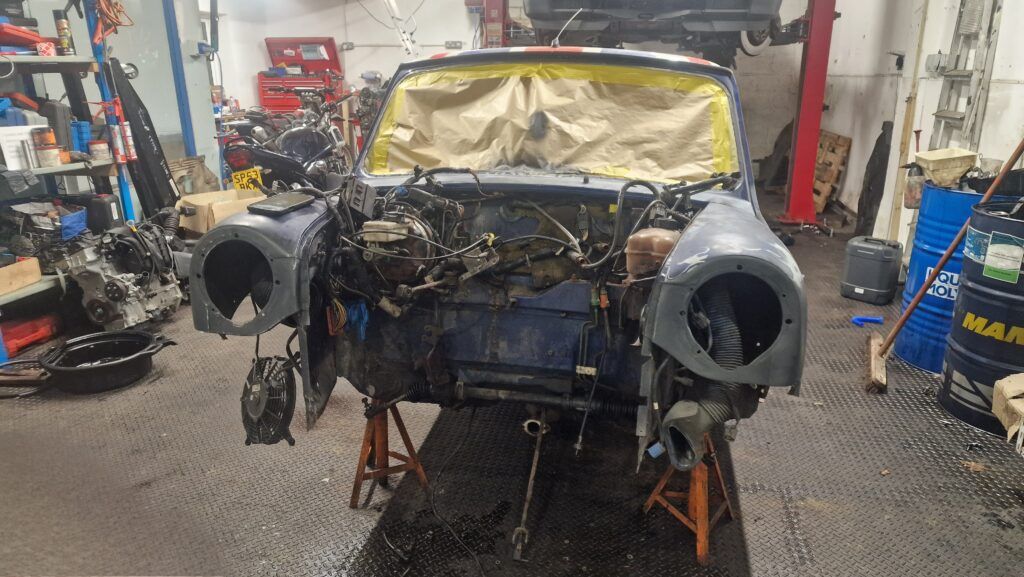
In his own words: “With my dad’s help I have grown a love of classics.” Alex has a Mk2 Escort project car of his own, and looks after several classic vehicles, among them a 1968 Morris Minor, and his dad’s Mini, built for sprints and hill climbs. Welding and rust repairs, troubleshooting, or a simple change of the points: SOMA is happy to help.
Behind that is the everyday training: a Bosch advanced apprenticeship (2016), then a small independent garage across a broad range of vehicles, then spells at Aston Martin, Jaguar Land Rover and Ford. Read more on the about page.
What we do on classics
- Servicing. Oil and filter with an oil suited to the engine, grease points, plugs, points and timing, valve clearances where the engine has adjustable tappets, brake adjustment and a look underneath. See car servicing.
- Mechanical repairs. Brakes, suspension, cooling, clutches and the rest of the running gear. Gearbox work is covered on the gearbox rebuild page.
- Troubleshooting. Starting problems, poor running, overheating and electrical faults, found the traditional way: testing, listening and checking one system at a time.
- Points and ignition. Setting or replacing contact breaker points and condensers, and setting the ignition timing.
- Welding and rust repairs. Cutting out corroded metal and welding in new, from a sill or a floor section to a chassis repair.
- MOTs. Alex is a qualified car and motorcycle MOT tester, so a classic can have its MOT here too, including a voluntary one. See the MOT page.
Rust and welding
Rust is the main enemy of an older car, and the worst of it hides: inside sills, under carpets, behind wheel arch liners and in box sections. A tester will fail serious corrosion near structural mounting points, such as suspension mounts and seat belt anchorages, and a repair has to be welded metal. Done properly, the rot is cut back to sound steel, a new section is shaped or bought in and welded in place, and the area is protected afterwards so the problem does not start again from the inside.
If your classic has bubbling paint, soft floors or a sill you are not sure about, send a few photos on WhatsApp first. It gives a starting point before the car is up on the ramp and the panels can be looked at properly.
Do classics still need an MOT?
Since 2018, cars built or first registered more than 40 years ago are exempt from the MOT, provided they have not been substantially changed in the last 30 years. You declare the exemption when you tax the car. The date rolls forward every year, so more cars become eligible each year.
Exempt does not mean unchecked. The car still has to be roadworthy every time it is driven, and the owner is responsible if it is not. That is why many classic owners still book a voluntary MOT: brakes, steering, suspension, lights and structure are checked by a tester on a schedule, which is worth having on a car that may sit for months between drives. The government page on historic vehicles has the rules in full.
Looking after a classic that is not used much
- Fuel. Standard petrol in the UK is now E10. For many older cars the advice is to use E5 super unleaded, as ethanol can affect older rubber fuel hoses and seals.
- Brakes. Cars that stand still for months tend to seize wheel cylinders and calipers, and brake fluid absorbs water with age whether the car moves or not.
- Tyres. Tyres age as well as wear. Good tread on a tyre that is many years old is not the same as a good tyre.
- Battery. A battery left connected on a car that stands will go flat; a conditioner or a disconnect helps.
Bringing your classic in
Call or send a WhatsApp to 07578 178468 with what the car is, what it needs, and a few photos if it is bodywork. If the car does not run, say so, and arrange how it gets to the workshop before you set off. The workshop is in Sarratt, near Rickmansworth, within a short drive of Chorleywood, Chipperfield, Kings Langley and Watford.